How to Use AI for Demand Forecasting in Small Business
Running a small business means making important decisions with limited time, money, and resources. You need to know which products customers will buy, how much inventory to keep, when to reorder supplies, and how to prepare for seasonal changes. But when demand is unpredictable, ordering too much can tie up your cash, while ordering too little can lead to missed sales.
This is where AI demand forecasting can help.
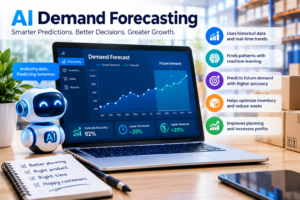
AI demand forecasting uses historical sales data, patterns, and other relevant information to estimate future customer demand. Small businesses can use these predictions to make better inventory decisions, plan promotions, prepare for busy periods, and manage purchasing more efficiently.
The best part is that you do not necessarily need an expensive software system or a dedicated data analyst to get started. You can begin with a spreadsheet and an AI assistant, then adopt more specialized forecasting software as your business grows.
In this guide, you’ll learn how AI demand forecasting works, which data you need, how to build your first forecast, which tools to consider, and how to measure whether your approach is working.
What Is AI Demand Forecasting?
AI demand forecasting is the process of using artificial intelligence and predictive analytics to estimate how much customers will want to buy in the future.
Traditional forecasting often relies on previous sales, averages, and manual estimates. AI-powered approaches can analyze larger combinations of variables, identify patterns, and update predictions as new data becomes available.
For example, a small clothing store might use AI to estimate demand for winter jackets by analyzing:
* Sales from previous winters.
* Current sales trends.
* Available inventory and outstanding orders.
* Planned discounts and advertising campaigns.
* Seasonal patterns and relevant market conditions.
* Supplier delivery times.
The resulting forecast can help the owner decide how many jackets to order and when to place the order.
AI forecasting does not predict the future with certainty. Unexpected events, changing customer preferences, supply disruptions, and inaccurate records can still lead to incorrect predictions. Its purpose is to make decisions more informed and consistent, not eliminate uncertainty.
Why Small Businesses Should Use AI for Demand Forecasting
Large companies may have dedicated planning teams, but small businesses often rely on spreadsheets, experience, and guesswork. AI can help make forecasting more systematic without requiring an enterprise-level operation.
1. Reduce Overstocking
Ordering too much inventory can leave your cash tied up in products that sell slowly. It can also increase storage expenses and the risk of products becoming outdated.
AI can help identify slower-selling items, seasonal demand patterns, and products that may not need frequent replenishment.
2. Prevent Stockouts
When a popular product sells out, customers may delay their purchase or buy from a competitor.
Demand forecasts can help you estimate future sales and plan replenishment before inventory runs out, provided your stock records and supplier lead-time information are reliable.
3. Improve Cash Flow Planning
Inventory purchases compete with other business expenses, including rent, payroll, marketing, and utilities.
A better demand forecast can help you plan purchasing more carefully and avoid committing too much cash to slow-moving products.
4. Prepare for Seasonal Demand
Many businesses experience predictable changes in demand during holidays, weather changes, school seasons, or special shopping events.
AI can analyze historical patterns and help you prepare for these changes. However, it needs enough relevant data to distinguish a recurring seasonal pattern from a one-time sales spike.
5. Make Better Marketing Decisions
Forecasting can also help you understand which products might need promotional support and which are likely to experience increased demand.
For example, if a product usually sells more during a particular season, you can coordinate advertising, inventory, and purchasing around that period.
6. Save Time on Repetitive Analysis
Instead of manually reviewing every product’s sales history, you can use AI tools to summarize trends, flag unusual changes, and prepare draft forecasts for review.
This allows business owners to spend more time making decisions and less time organizing data.
How Does AI Demand Forecasting Work?
Most AI demand forecasting workflows involve five basic steps.
Step 1: Collect historical data. Gather past sales, inventory levels, returns, promotions, and relevant seasonal information.
Step 2: Identify patterns. The forecasting system looks for trends, recurring seasonal changes, and relationships between variables.
Step 3: Generate a forecast. The system estimates future demand for a chosen period, such as the next week, month, or quarter.
Step 4: Review the results. Compare the prediction with business knowledge, planned promotions, supplier constraints, and recent changes.
Step 5: Update the forecast. As new sales data arrives, review the prediction and adjust purchasing plans where necessary.
The specific technology varies. Some tools use statistical forecasting models, others use machine learning, and some combine both with generative AI assistants that explain the results. A tool that uses AI to summarize a spreadsheet is not necessarily running a specialized predictive forecasting model.
For more technical background, see IBM’s guide to AI demand forecasting.
Step 1: Collect the Right Business Data
Your forecast is only as reliable as the information behind it. Before choosing an AI tool, organize the data your business already collects.
Essential data for demand forecasting
Data type What it tells you
Historical sales How many units sold during each period
Product information Which product or SKU each sale belongs to
Inventory levels What is currently available to sell
Returns and cancellations Which sales did not become completed purchases
Promotions When discounts or advertising may have affected demand
Supplier lead times How long replenishment usually takes
Seasonal information When demand tends to increase or decrease
Ideally, collect at least 12 months of sales history if your business is seasonal. More history can help identify recurring patterns, although new businesses can begin with less data and use simpler methods.
For each transaction or time period, use consistent dates, product identifiers, units, and sales definitions. If you sold 100 items but 10 were returned, make sure your reporting clearly distinguishes gross sales from net sales.
Also, record periods when products were out of stock. If an item was unavailable for a week, low recorded sales may reflect a lack of inventory rather than low customer demand.
Beginner tip: If your sales information is scattered across invoices, marketplace reports, and handwritten records, start by consolidating the most important information into one spreadsheet.
Step 2: Choose the Right AI Forecasting Method
Not every small business needs advanced machine learning. The best method depends on your sales history, business model, product range, and forecasting needs.
Method 1: Spreadsheet forecasting with an AI assistant
This is a practical starting point for businesses with limited budgets and a manageable number of products.
You can use a spreadsheet to organize sales data and an AI assistant to identify trends, check formulas, summarize results, and explain possible scenarios.
An AI assistant can help you build a forecast, but you should verify the calculations and assumptions rather than accepting every generated answer.
Method 2: AI-enabled inventory software
Inventory forecasting software can connect sales and stock records, estimate future demand, and generate purchasing recommendations.
This approach is useful for ecommerce sellers, retailers, and wholesalers managing many products or several sales channels.
Method 3: Specialized predictive analytics
Businesses with larger datasets, multiple locations, or more complex supply chains may benefit from dedicated forecasting models that consider promotions, seasonality, supplier constraints, and other variables.
This method can be powerful, but it may require more setup, cleaner data, and technical support.
For most small businesses, a sensible approach is to begin with the simplest method that solves the actual problem.
Step 3: Build Your First AI Demand Forecast
You do not need to automate your entire business to begin forecasting. Start with one product category or a small group of your best-selling items.
A simple example
Imagine you run a small online store selling reusable water bottles.
Your sales over the last four months were:
Month Units sold
May 80
June 100
July 120
August 140
Sales increased by 20 units each month. A simple trend-based estimate would suggest 160 units for September.
However, this is only a baseline. The increase may not continue, and the forecast does not account for price changes, advertising, stockouts, or seasonal effects.
A simple average of the four months would be 110 units per month. Comparing the average with the trend estimate shows why choosing a method matters: the average smooths out changes, while the trend-based estimate assumes recent growth will continue.
Neither number is automatically correct.
How to use an AI assistant
Prepare a spreadsheet containing your historical sales, product details, current stock, planned promotions, and supplier lead times.
Then use a prompt like this:
“Analyze the attached sales data for my small business. Identify trends and unusual changes, create a baseline forecast for the next four weeks, and explain the assumptions used. Consider seasonality, promotions, stockouts, and supplier lead times where the data supports them. Compare the forecast with a simple historical-average baseline, explain the limitations, and identify which products need human review. Do not invent missing data. Clearly label assumptions and uncertainty.”
Review the output carefully. If the assistant invents missing figures, uses the wrong date range, or treats an out-of-stock period as zero demand, correct the inputs before using the results.
A spreadsheet-based baseline is particularly valuable because it gives you a simple benchmark against which to evaluate a more sophisticated AI forecast.
Step 4: Turn the Forecast Into Inventory Decisions
A demand forecast becomes useful when it changes what you do.
Suppose your forecast estimates that you will sell 160 water bottles over the next month. You currently have 50 units available, and your supplier takes two weeks to deliver new stock.
You should not automatically order 110 units. First, determine how much demand may occur before the delivery arrives, account for any stock already on order, and consider the inventory buffer you need.
A basic reorder-point formula is:
Reorder point = Average daily demand × Supplier lead time in days + Safety stock
For example, if average demand is 4 units per day, your supplier lead time is 14 days, and you choose a safety stock of 15 units:
Reorder point = (4 × 14) + 15 = 71 units.
This means you would generally consider replenishment when your inventory position reaches about 71 units, assuming the inputs and ordering policy are appropriate.
Inventory position typically includes usable stock on hand plus confirmed incoming stock, minus outstanding commitments or backorders.
The example is illustrative, not a universal inventory rule. For seasonal or highly variable products, use demand estimates for the actual lead-time period rather than relying only on a long-term average.
AI can help estimate demand and identify changing patterns, but you should still consider minimum order quantities, storage capacity, supplier reliability, cash availability, and the risk of products becoming obsolete.
Step 5: Use AI to Account for Promotions and Seasonality
Historical sales alone may not explain why demand changes. External events and business decisions can influence future purchases.
For example, a skincare shop might sell more sunscreen during warmer months. An online clothing store may experience increased demand during a major sale, while a stationery business may see a spike before schools reopen.
To improve your forecasts, record events such as:
* Seasonal shopping periods and public holidays.
* Planned discounts and advertising campaigns.
* Product launches or discontinued products.
* Price changes.
* Supplier disruptions.
* Unusual one-time orders.
* Relevant weather or local events, where they genuinely affect demand.
Do not assume every external variable improves forecasting. Add variables only when they are relevant and you have a reasonable way to measure them.
When planning a major promotion, build alternative scenarios rather than assuming that a previous campaign’s results will repeat exactly.
For example:
* Lower-demand scenario: The promotion generates little additional interest.
* Expected scenario: Sales rise by an amount supported by previous comparable campaigns.
* Higher-demand scenario: The campaign performs unusually well.
Use these scenarios to plan inventory and cash requirements. Keep the assumptions visible so you can update them when actual sales arrive.
Step 6: Choose AI Demand Forecasting Tools for Your Business
The right tool depends on your sales channels, budget, number of products, and current software.
Here are several categories worth considering.
General-purpose AI assistants
Tools such as ChatGPT can help analyze structured sales data, explain trends, draft spreadsheet formulas, and develop forecasting workflows.
They are useful for businesses that want to experiment without immediately adopting a dedicated inventory platform. However, a general-purpose assistant is not automatically a continuously updated forecasting engine. You need to supply reliable data, verify its calculations, and protect sensitive customer and business information.
Spreadsheet tools
Microsoft Excel and Google Sheets can organize historical sales, calculate averages, track trends, and create basic forecasts. AI features or assistants may help with analysis, depending on the product, plan, and availability.
Spreadsheets are often sufficient for a small product range, although manual updates can become burdensome as the business grows.
Ecommerce inventory forecasting software
Shopify-based businesses may consider inventory apps that connect sales and stock records with forecasting or replenishment workflows. Shopify’s AI demand forecasting guide discusses data preparation, forecasting workflows, and software selection.
Other inventory platforms may suit businesses selling across multiple marketplaces or managing wholesale and retail orders.
Before choosing a product, confirm that it supports your sales channels, currency, product catalog, supplier lead times, and required reporting.
Dedicated demand planning software
More advanced planning tools may be useful when you manage many products, several warehouses, manufacturing inputs, or complex purchasing schedules.
These systems can offer more detailed scenario planning and automated replenishment, but implementation costs and complexity may be unnecessary for a small operation.
How to compare forecasting tools
Evaluate tools against your actual needs rather than choosing the one with the most AI features.
Ask:
1. Can it import my sales and inventory data?
2. Does it account for stockouts, returns, and promotions?
3. Can it forecast demand by product or SKU?
4. Does it incorporate supplier lead times?
5. Can I compare forecasts with actual sales?
6. Can I export my data if I change providers?
7. Are the total costs reasonable for my business?
8. Does it explain its assumptions and let me review recommendations?
Start with a trial or small pilot if available. Verify current pricing and feature availability directly with each provider before committing.
Step 7: Measure Whether Your AI Forecast Is Working
A forecast that looks convincing is not necessarily accurate. To determine whether AI is helping, compare its predictions with actual results.
Forecast accuracy
One straightforward metric is mean absolute error (MAE). It calculates the average size of the difference between forecast demand and actual demand.
For example, suppose your weekly forecasts and actual sales differ by 5, 10, 3, and 6 units.
MAE = (5 + 10 + 3 + 6) ÷ 4 = 6 units.
Your forecast was off by an average of six units per week across those four observations.
You can also use weighted absolute percentage error (WAPE) when comparing errors across products with different sales volumes, provided the total actual demand is not zero.
Accuracy metrics should be interpreted alongside the business context. Underforecasting a fast-selling, high-margin product may be more costly than overforecasting a slow-moving product.
Track business outcomes too
Monitor:
* How often products run out of stock.
* How much inventory remains unsold.
* Inventory holding costs.
* Emergency purchasing and expedited shipping costs.
* Supplier delivery performance.
* Forecast error by product category.
Compare results against your previous forecasting method over comparable periods. Do not attribute every improvement to AI; changes in pricing, supplier performance, marketing, and customer demand can also affect the outcome.
Step 8: Create a Simple 30-Day Implementation Plan
You can test AI demand forecasting without changing every business process at once.
Week 1: Organize your data
Collect sales history, stock levels, supplier lead times, and relevant promotional information. Correct missing dates, duplicate records, and inconsistent product identifiers.
Week 2: Establish a baseline
Select a few important products and build a basic forecast using a historical average or a simple trend. Record the assumptions behind each estimate.
Week 3: Test an AI-assisted forecast
Use an AI assistant or a forecasting tool to generate predictions for the same products and period. Compare the results with your baseline and review any major differences.
Week 4: Review and improve
Compare forecasts with actual sales where enough data is available. Identify recurring errors, update assumptions, and decide whether a more specialized tool would provide meaningful value.
A 30-day pilot is a way to evaluate the process, not a guarantee that the forecast will become accurate within a month. Seasonal businesses may need several months or a full seasonal cycle to assess performance properly.
Common Mistakes to Avoid When Using AI for Demand Forecasting
1. Using Incomplete Sales Data
Missing transactions, inaccurate inventory counts, and unrecorded stockouts can distort forecasts. Improve your records before expecting advanced predictions to solve the problem.
2. Treating Predictions as Guarantees
AI estimates future demand; it does not know what customers will actually buy. Review forecasts against current business conditions.
3. Ignoring Supplier Lead Times
A forecast may correctly predict higher demand but still fail to prevent stockouts if the order is placed too late. Include delivery time and incoming stock in purchasing decisions.
4. Overcomplicating the Process
You do not need a sophisticated forecasting system for every product. Start with the products where forecast errors have the greatest effect on sales, costs, or customer satisfaction.
5. Automating Purchases Too Early
Automatically ordering products based on an untested model can create expensive mistakes. Validate the forecast, establish spending limits, and require human approval until the process has proved reliable.
6. Ignoring Privacy and Data Security
Sales reports may contain customer information, supplier terms, or other confidential details. Share only the data needed for analysis, remove unnecessary personal information, and review the tool’s privacy and data-handling settings.
Is AI Demand Forecasting Worth It for Small Businesses?
AI demand forecasting can be worthwhile when inaccurate purchasing decisions create recurring costs or lost sales.
A small retailer with a few products may get sufficient value from a spreadsheet and periodic AI-assisted analysis. An ecommerce business with hundreds of products and multiple sales channels may benefit more from dedicated inventory forecasting software.
The decision should be based on the problem you need to solve, the quality of your data, the time required to maintain the process, and the cost of the tool.
Start by identifying one measurable problem, such as frequent stockouts or excess inventory. Test a basic forecast, compare its performance with your existing method, and expand only when the results justify the additional effort.
Frequently Asked Questions
Can a small business use AI for demand forecasting without coding?
Yes. A small business can begin with spreadsheets, AI assistants, or forecasting software that offers a graphical interface. Coding is generally unnecessary for a basic pilot, although advanced customization may require technical skills.
How much historical data is needed for AI demand forecasting?
There is no universal minimum. Several months of consistent data may support an initial baseline, while a seasonal business often benefits from at least 12 months or more. The amount required depends on the product, forecast horizon, seasonality, and method.
What is the difference between AI demand forecasting and sales forecasting?
Demand forecasting estimates the quantity of products or services customers are likely to want. Sales forecasting may focus on revenue, units sold, or broader sales performance. The two overlap, but demand forecasts can also support inventory, purchasing, and capacity planning.
Is AI demand forecasting accurate?
Accuracy depends on data quality, demand variability, the forecasting method, and how frequently assumptions are updated. AI may improve forecasts in some situations, but it can also perform poorly when products are new, demand changes suddenly, or historical records are unreliable.
Which AI tool is best for demand forecasting in a small business?
There is no single best tool for every business. Spreadsheet-based workflows can suit simple operations, while ecommerce sellers with many products may prefer inventory software with built-in forecasting. Choose based on data integrations, forecast evaluation, usability, and total cost.
Can AI predict demand for a new product?
Forecasting a new product is difficult because it lacks its own sales history. You can use information from comparable products, planned marketing activity, market research, and similar launches, but the result will contain more uncertainty. Review actual sales frequently and avoid placing large orders solely on an untested prediction.
How often should a business update its demand forecast?
It depends on how quickly demand changes and how long replenishment takes. A fast-moving online store may review key products weekly or more often, while a business with stable demand may use a less frequent schedule. Update forecasts when meaningful new sales, promotion, or supply information becomes available.
Final Thoughts
AI demand forecasting gives small businesses a practical way to replace some guesswork with structured, data-informed decisions. It can help you anticipate sales, manage inventory, plan purchasing, and prepare for changing customer demand.
You do not need to start with expensive software. Organize your data, build a simple baseline, test an AI-assisted forecast, and measure the results against actual sales.
Most importantly, treat AI as a decision-support tool rather than an automatic authority. Combining reliable data, sensible forecasting methods, and human judgment gives your business a stronger foundation for planning growth.