AI Lead Scoring: How Predictive Scoring Works and How to Implement It
Not every lead deserves the same amount of attention.
A sales team might have hundreds or thousands of leads in its CRM, but only a fraction may have a strong combination of customer fit, buying interest, and conversion potential. The challenge is figuring out which prospects should receive attention first.
Traditional lead scoring attempts to solve this problem by assigning points according to predefined rules.
For example:
- +10 points for downloading an ebook
- +20 points for requesting a demo
- +5 points for opening an email
- +15 points for having a target job title
- -10 points for being outside the target market
The problem is that manually created rules do not always capture the complicated patterns hidden in historical sales data.
This is where AI lead scoring comes in.
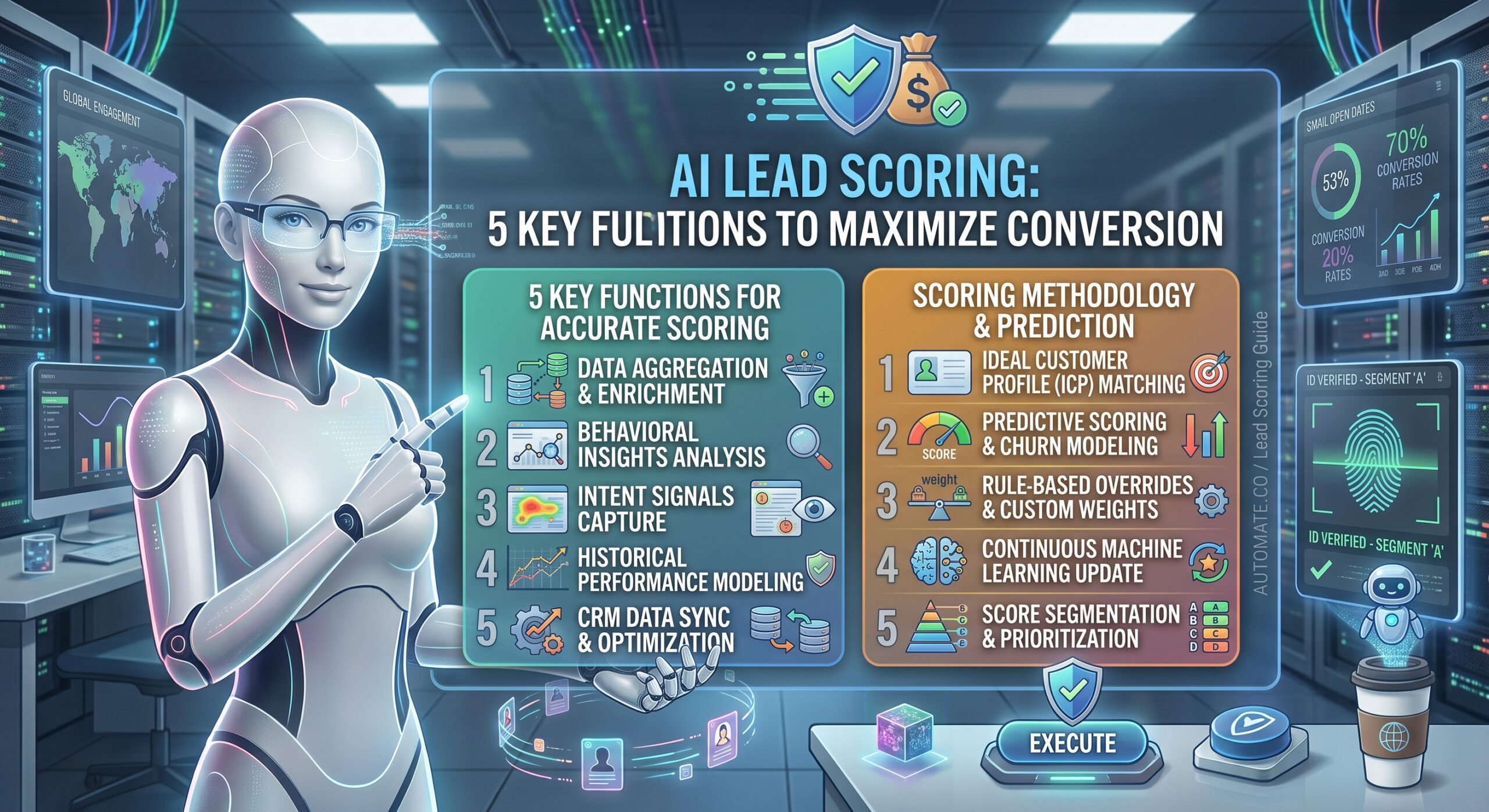
AI-powered lead scoring uses machine learning and historical business data to identify patterns associated with successful conversions and use those patterns to prioritize current leads. Salesforce, for example, describes Einstein Lead Scoring as using machine learning to analyze historical conversion patterns and identify current leads that resemble previously converted leads.
Modern systems can go beyond simply adding points for individual actions. Depending on the platform, AI may analyze customer characteristics, engagement behavior, historical conversion data, and other signals to estimate which leads deserve sales attention.
But AI lead scoring is not simply a magic number generated by a machine.
For it to work well, businesses need appropriate data, clearly defined conversion goals, good CRM hygiene, sensible workflows, and a process for turning scores into action.
This guide explains how AI lead scoring works, how it differs from traditional scoring, what data models can use, how to implement it, and how to measure whether it is actually improving your sales process.
What Is AI Lead Scoring?
AI lead scoring is the use of artificial intelligence and machine learning to estimate the likelihood that a lead will become a desired business outcome, such as a qualified opportunity or customer.
Instead of relying entirely on manually defined scoring rules, an AI model can learn patterns from historical data.
For example, imagine a company has thousands of historical leads.
Some converted into customers.
Others did not.
An AI model can analyze the differences between these groups and identify patterns associated with conversion.
It might discover that successful leads are more likely to have certain combinations of:
- Company size
- Industry
- Job role
- Geographic location
- Product interest
- Website behavior
- Previous interactions
- Marketing engagement
- Sales activity
- Other available CRM information
The model can then apply those learned patterns to current leads.
Salesforce’s Einstein Lead Scoring documentation describes essentially this process: the system analyzes past leads and identifies current leads that have characteristics in common with previously converted leads.
The result is a predictive score that can help sales and marketing teams prioritize their work.
How Does AI Lead Scoring Work?
Although implementations differ between platforms, the basic process usually follows several stages.
1. Collect Lead Data
The model needs information about leads.
Depending on the business and platform, this can include:
- Contact information
- Company information
- Job title
- Industry
- Company size
- Geographic information
- Website activity
- Email engagement
- Form submissions
- Content interactions
- Previous sales activity
- CRM history
- Lead source
- Product interest
- Conversion history
The quality and completeness of this data matter.
If important information is missing or inconsistent, the model has less useful information from which to identify patterns.
Salesforce specifically recommends providing more lead data because additional information can improve the insights generated by Einstein Lead Scoring.
2. Identify Historical Outcomes
AI needs to understand what the business considers success.
For example, the desired outcome could be:
Lead → Qualified opportunity
or:
Lead → Customer
This distinction is important.
A lead scoring model designed to predict demo bookings is not necessarily the same as a model designed to predict closed-won revenue.
The business needs to define the outcome before evaluating whether the model works.
3. Find Patterns
The machine-learning system analyzes historical records to identify relationships between lead characteristics and outcomes.
For example, it may discover that a certain combination of company characteristics and engagement behavior has historically been associated with higher conversion rates.
The model does not necessarily rely on a simple formula such as:
Job title = +10 points.
Instead, it can identify patterns across multiple variables.
4. Generate Predictions
The model applies its learned patterns to current leads.
Each lead receives a score or prediction that helps indicate how closely its characteristics match the patterns associated with the desired outcome.
Salesforce explains that its Einstein Lead Scoring system creates predictive models based on historical lead-conversion patterns.
5. Explain Influencing Factors
Modern AI systems increasingly provide information about why a prediction was generated.
For example, Salesforce’s system can show fields with significant positive or negative influence on an individual lead’s score.
This is important because a sales representative should ideally be able to understand more than:
“This lead has a score of 87.”
They should also be able to understand:
“This lead scored highly because its company profile and recent engagement resemble patterns associated with successful conversions.”
Explainability makes AI scoring more useful operationally.
AI Lead Scoring vs. Traditional Lead Scoring
The biggest difference between AI lead scoring and traditional lead scoring is how the scoring logic is created.
Traditional Lead Scoring
Traditional systems usually depend on rules created by humans.
For example:
| Lead behavior | Example score |
|---|---|
| Opens an email | +2 |
| Visits pricing page | +10 |
| Downloads a guide | +5 |
| Requests demo | +25 |
| Target industry | +10 |
| Target job title | +10 |
| Unsubscribes | -20 |
The organization decides which activities receive points.
This approach is relatively simple and transparent.
It can also be highly useful when a business has limited historical data.
AI Lead Scoring
AI scoring attempts to discover patterns from historical data.
Instead of telling the system:
“A pricing-page visit should be worth 10 points.”
the organization provides historical data and a desired outcome, and the model learns which factors are associated with that outcome.
Salesforce describes Einstein Lead Scoring as a machine-learning approach intended to identify conversion patterns rather than relying only on traditional rules.
The practical difference
Traditional scoring asks:
“What rules do we believe indicate a good lead?”
AI scoring asks:
“What patterns in our historical data are associated with successful leads?”
Neither approach automatically works in every situation.
The right method depends on the quality, quantity, and relevance of the available data.
What Data Does AI Lead Scoring Use?
AI lead scoring can potentially use many different types of information.
Firmographic Data
For B2B businesses, firmographic information can be particularly useful.
Examples include:
- Industry
- Company size
- Revenue range
- Location
- Business model
- Number of employees
- Department
- Technology environment
This information helps determine whether a lead resembles the company’s ideal customer profile.
Demographic or Contact Data
Depending on the business and applicable privacy requirements, models may consider information such as:
- Job title
- Seniority
- Department
- Geographic location
- Role
The purpose is to determine whether the person is likely to be relevant to the product or service.
Behavioral Data
Behavior can provide signals about engagement.
Examples include:
- Website visits
- Product-page visits
- Pricing-page visits
- Form submissions
- Content downloads
- Email interactions
- Webinar attendance
- Demo requests
- Product usage
Behavioral signals can help distinguish between someone who simply entered a database and someone who is actively engaging with a company.
Historical Sales Data
Historical CRM data is especially important for predictive scoring.
Models can analyze patterns associated with:
- Converted leads
- Lost leads
- Sales opportunities
- Customer acquisition
- Lead sources
- Sales-cycle outcomes
Salesforce states that Einstein Lead Scoring analyzes past leads to identify patterns associated with conversion.
Engagement Data
AI systems may also incorporate interactions across multiple channels.
Depending on the platform, this could include:
- Email engagement
- Website activity
- Sales interactions
- Marketing campaigns
- Content engagement
- Conversation history
The goal is to build a more complete picture of the prospect.
What Is Predictive Lead Scoring?
Predictive lead scoring is a form of lead scoring that uses statistical or machine-learning models to estimate the likelihood of a desired outcome.
The term is often used interchangeably with AI lead scoring, although implementations can differ.
The basic concept is:
Historical data → Machine-learning model → Prediction → Lead prioritization
For example:
A company has 20,000 historical leads.
Of those, 1,500 eventually became customers.
The model analyzes the characteristics and behaviors of these leads and looks for patterns that distinguish customers from non-customers.
It then applies those patterns to current leads.
The resulting prediction can help sales teams determine which leads should be contacted first.
Why Is AI Lead Scoring Important?
Sales teams often have a capacity problem.
There may be more leads than sales representatives can realistically contact and qualify manually.
Without prioritization, representatives may spend time on leads that have little potential while higher-quality opportunities wait.
AI lead scoring can help solve this prioritization problem.
Faster Lead Prioritization
Instead of reviewing every lead manually, representatives can focus first on leads with stronger predictive signals.
More Consistent Qualification
AI can apply the same model across large numbers of leads.
This can reduce some forms of inconsistency that occur when individual representatives use different judgment criteria.
Better Sales-Market Alignment
A well-designed model can help marketing and sales teams develop a shared definition of lead quality.
Reduced Manual Analysis
Instead of manually comparing thousands of historical records, AI can analyze large datasets and surface patterns.
More Actionable CRM Data
A lead score becomes more valuable when it directly affects workflow.
For example:
High score → Sales follow-up
Medium score → Nurturing
Low score → Continue marketing engagement
Salesforce supports this type of workflow approach by allowing prediction scores to be used in automation and business flows.
AI Lead Scoring Is Not the Same as Lead Qualification
These concepts are related but not identical.
Lead scoring
Assigns a score or prediction to indicate potential value or likelihood of conversion.
Lead qualification
Determines whether a lead meets specific criteria for sales attention.
Lead grading
Often evaluates how well a lead fits a predefined ideal customer profile.
Lead prioritization
Determines which leads should receive attention first.
A business may combine all four.
For example:
Fit: Excellent
Engagement: High
Intent: Strong
Predictive conversion score: High
Sales priority: Immediate
This is more informative than relying on one number alone.
Salesforce’s current scoring documentation illustrates this broader approach, with account scoring incorporating dimensions such as fit, engagement, and intent in certain workflows.
AI Lead Scoring for B2B Sales
AI lead scoring can be particularly useful in B2B sales because B2B organizations often have complex customer profiles.
A B2B model may need to consider:
- Company industry
- Employee count
- Revenue
- Technology
- Geography
- Job function
- Seniority
- Account activity
- Buying signals
- Historical sales outcomes
For example, a software company selling an enterprise product might consider a large organization with the appropriate technology environment and active engagement more relevant than a small company outside its target market.
AI can potentially discover combinations of these characteristics that are associated with successful sales.
How to Implement AI Lead Scoring
Implementing AI lead scoring should be treated as a business project, not simply a software installation.
Step 1: Define the Business Outcome
First decide what the model should predict.
Possible outcomes include:
- Lead becomes marketing-qualified
- Lead becomes sales-qualified
- Lead books a meeting
- Lead becomes an opportunity
- Opportunity becomes a customer
Be specific.
“Good lead” is not a measurable outcome.
Step 2: Define Your Ideal Customer
Document your target customer.
Consider:
- Industry
- Company size
- Revenue
- Geography
- Job role
- Business model
- Common pain points
- Existing technology
- Buying behavior
This provides useful context for interpreting the model.
Step 3: Audit Your CRM Data
Look for:
- Duplicate records
- Missing fields
- Incorrect job titles
- Old contacts
- Inconsistent industry values
- Incorrect lead statuses
- Poorly recorded conversion outcomes
AI cannot compensate indefinitely for poor data quality.
Step 4: Determine Whether You Have Enough Historical Data
Predictive models need historical examples.
Salesforce’s Einstein Lead Scoring documentation, for example, lists requirements including at least 1,000 leads created in the previous 200 days and at least 120 converted leads for its standard setup.
This is a vendor-specific requirement, not a universal threshold for every AI lead scoring system.
The broader principle is more important:
A predictive model needs enough relevant historical outcomes to learn meaningful patterns.
Step 5: Select the Right Scoring Tool
Potential options include:
- CRM-native AI scoring
- Marketing automation platforms
- Sales intelligence platforms
- Customer-data platforms
- Custom machine-learning systems
Look for:
- Data integration
- Explainability
- Customization
- Automation
- CRM compatibility
- Reporting
- Model refresh frequency
- Privacy and security controls
Step 6: Build the Model
Configure the desired outcome and relevant data.
Where possible, avoid including information that does not have a legitimate business purpose.
Step 7: Validate the Results
Do not immediately assume a high score means a lead is valuable.
Compare scores against actual outcomes.
Ask:
- Do high-scoring leads convert more often?
- Are important customer segments being missed?
- Are there obvious false positives?
- Are there false negatives?
- Are certain lead sources consistently over- or under-scored?
Step 8: Connect Scores to Actions
A score without an action plan has limited value.
Create clear workflows.
For example:
High predictive score
→ Sales representative receives task
→ Lead researched
→ Personalized outreach begins
Medium score
→ Automated nurturing
→ Monitor engagement
Low score
→ Remain in marketing pool
→ Re-evaluate when new signals appear
Step 9: Monitor and Refresh
Customer behavior changes.
Markets change.
Products change.
Sales strategies change.
A model that worked last year may not perform the same way today.
Salesforce’s Einstein Lead Scoring documentation states that its models are periodically reanalyzed and that scores are updated as needed.
Your own system should similarly be monitored rather than treated as permanently correct.
How to Know Whether Your AI Lead Scoring Model Works
Do not judge the model simply because it produces scores.
Judge it based on outcomes.
Conversion Rate by Score
Compare conversion rates across score ranges.
For example:
| Score range | Leads | Conversion rate |
|---|---|---|
| High | 500 | Measure |
| Medium | 2,000 | Measure |
| Low | 7,500 | Measure |
The exact numbers will differ by business.
The important question is:
Do higher scores correspond to better outcomes?
Salesforce itself provides reporting around conversion rate by lead score in its Einstein Lead Scoring functionality.
Precision
How many of the leads identified as high-priority actually become valuable opportunities?
Recall
How many of the genuinely valuable leads does the system successfully identify?
Sales Acceptance
Do sales representatives believe the high-scoring leads are actually useful?
Pipeline Impact
Does prioritization lead to more qualified opportunities?
Revenue Impact
Ultimately, does the scoring system contribute to better commercial outcomes?
Common AI Lead Scoring Mistakes
Mistake 1: Using Poor Data
Bad CRM data can produce unreliable predictions.
Clean the data before relying heavily on the model.
Mistake 2: Optimizing for the Wrong Outcome
A model predicting email engagement is not necessarily a model predicting revenue.
Choose an outcome that matters to the business.
Mistake 3: Treating the Score as Absolute Truth
A score is a prediction.
It is not a guarantee.
A high-scoring lead can still fail to convert.
A low-scoring lead can still become an excellent customer.
Mistake 4: Ignoring Explainability
Sales representatives need context.
If users do not understand why leads are prioritized, they may ignore the model.
Modern predictive systems increasingly expose influential factors. Salesforce’s Einstein scoring, for example, shows factors with significant positive or negative influence on scores.
Mistake 5: Never Updating the Model
Markets evolve.
Customer preferences change.
Products change.
Lead sources change.
The model should be evaluated regularly.
Mistake 6: Using Too Many Signals
More data is not automatically better.
Irrelevant, noisy, outdated, or poorly collected signals can make a model harder to interpret and potentially less useful.
AI Lead Scoring and Data Privacy
AI lead scoring involves analyzing customer and prospect information, so privacy and governance should be part of the implementation.
Before enabling AI scoring, businesses should understand:
- What data enters the model
- Where the data is processed
- Who can access scores
- Whether third-party data is involved
- How long data is retained
- How sensitive fields are handled
- Whether automated decisions require additional safeguards
Organizations should also consider applicable privacy laws and their own internal policies.
The safest approach is to collect and use only the information necessary for a legitimate business purpose and to apply appropriate access controls.
AI Lead Scoring vs. Manual Lead Scoring
| Factor | Manual/Rule-Based | AI/Predictive |
|---|---|---|
| Scoring logic | Human-defined | Learned from data |
| Setup | Usually simpler | More involved |
| Transparency | Usually high | Depends on platform |
| Historical data requirement | Lower | Generally higher |
| Pattern detection | Limited to defined rules | Can identify complex patterns |
| Adaptability | Requires manual changes | Can retrain/recalculate |
| Scale | Good | Very good |
| Human control | High | Requires governance |
| Best use | Clear, simple criteria | Data-rich environments |
This is not a question of replacing every rule with AI.
Many businesses can use a hybrid approach.
Hybrid AI Lead Scoring: The Practical Approach
A hybrid system can combine:
Human-defined rules + AI predictions + business logic
For example:
Rule-based fit
Target industry = +20
AI prediction
Predicted conversion likelihood = High
Engagement
Recent pricing-page activity = High
Business rule
Enterprise account = Priority
The resulting workflow could then prioritize the account.
This approach gives businesses more control while still benefiting from predictive modeling.
When Should a Business Use AI Lead Scoring?
AI lead scoring may be worth considering when:
- You generate many leads
- Sales representatives cannot review every lead
- You have meaningful historical conversion data
- Your CRM contains reasonably reliable information
- Lead quality varies substantially
- Sales teams need better prioritization
- You want to automate lead routing
- Marketing and sales need a shared prioritization system
It may be less useful when:
- You have very few leads
- Your customer base changes constantly
- Your CRM data is extremely incomplete
- You have almost no historical conversions
- Your sales process is highly relationship-driven and small-scale
- There is no clear business outcome to predict
In these situations, a straightforward rules-based system may be easier to manage.
AI Lead Scoring Tools and Platforms
AI lead scoring can be available as part of larger CRM and marketing platforms rather than as a standalone product.
Salesforce Einstein Lead Scoring
Salesforce’s Einstein Lead Scoring analyzes historical lead data using machine learning and predicts which current leads resemble previously converted leads. It can also expose influential fields behind individual scores.
HubSpot Lead Scoring
HubSpot provides lead-scoring functionality with AI insights that can identify high-impact events using conversion data. Its August 2026 documentation describes using conversion rates and confidence levels to help establish scoring criteria.
Custom AI Models
Larger organizations may also build custom predictive models using their own data infrastructure.
This can provide greater control but generally requires more technical resources, data expertise, monitoring, and governance.
When comparing tools, focus on capabilities rather than marketing labels.
Ask:
- What data does the system analyze?
- What outcome does it predict?
- Can we see why a lead received its score?
- Can the score trigger workflows?
- How frequently is the model updated?
- Can we customize the model?
- Does it integrate with our CRM?
- What happens when data is insufficient?
A Simple AI Lead Scoring Framework
For a business starting from scratch, use this five-part framework:
1. Fit
Does this lead match our ideal customer?
2. Intent
Does the lead appear to have a relevant need?
3. Engagement
Is the lead interacting with our business?
4. History
What patterns do similar leads have?
5. Action
What should our team do next?
The fifth step is frequently overlooked.
A score should not merely sit inside the CRM.
It should influence an action.
The Future of AI Lead Scoring
AI lead scoring is evolving from simple predictive numbers toward more contextual sales intelligence.
Modern AI systems increasingly connect scoring with:
- Lead research
- Intent signals
- Personalization
- Lead routing
- Automated nurturing
- Next-best-action recommendations
- Sales workflows
Salesforce’s current prediction tooling, for example, allows predictive outputs to be incorporated into workflows and provides top predictors and recommendations in certain implementations.
This points toward a broader shift:
The future of lead scoring is not just deciding which lead has the highest score.
It is helping sales and marketing teams understand:
Who should we prioritize? Why? What should we do next? And did that action produce the desired result?
That makes AI lead scoring part of a broader revenue-operations workflow rather than an isolated CRM feature.
Frequently Asked Questions About AI Lead Scoring
What is AI lead scoring?
AI lead scoring uses artificial intelligence and machine learning to analyze lead data and estimate which leads are most likely to achieve a desired outcome, such as becoming an opportunity or customer.
How is AI lead scoring different from traditional lead scoring?
Traditional scoring generally uses manually defined rules. AI lead scoring uses historical data and machine-learning models to identify patterns associated with successful outcomes.
What data does AI lead scoring need?
Depending on the system, it can use company information, contact attributes, website activity, engagement, CRM history, lead source, sales activity, and historical conversion data.
Is predictive lead scoring the same as AI lead scoring?
The terms overlap significantly. Predictive lead scoring generally refers to using statistical or machine-learning methods to predict lead outcomes, while AI lead scoring is a broader term that can include predictive modeling and other AI capabilities.
Can small businesses use AI lead scoring?
Yes, but the value depends on the amount and quality of available data. Businesses with relatively few leads or conversions may find a simple rules-based scoring system easier to manage.
How accurate is AI lead scoring?
Accuracy varies by business, data quality, model design, and the outcome being predicted. A score should be evaluated against actual conversion results rather than treated as a guarantee.
Does AI replace sales representatives?
No. AI lead scoring primarily helps prioritize and organize sales work. Sales representatives still need to validate prospects, communicate with customers, handle objections, and make important decisions.
How often should AI lead scoring models be reviewed?
There is no universal schedule. Businesses should monitor performance and reassess models when conversion patterns, products, markets, customer segments, or data quality change.
What is the most important factor in AI lead scoring?
There is no single universal factor. A useful system depends on having a clearly defined business outcome, relevant historical data, reliable CRM information, and a workflow that turns predictions into appropriate actions.
Final Takeaway
AI lead scoring can help businesses move from “treat every lead the same” toward a more data-driven approach to sales prioritization.
Traditional lead scoring asks businesses to define the rules.
AI lead scoring can analyze historical outcomes and discover patterns that may be difficult to identify manually.
The most effective implementation, however, is not simply:
Collect data → generate score → contact high-score leads.
A stronger process is:
Define the outcome → clean the data → train or configure the model → validate predictions → understand the factors → connect scores to workflows → measure real outcomes → continuously improve.
AI lead scoring works best when it becomes part of the broader sales process.
The score itself is not the objective.
Better prioritization, faster follow-up, more relevant sales activity, and measurable business outcomes are the real objectives.