Best AI Tools for Marketing Agencies in 2026: 20 Tools to Scale Client Work
Marketing agencies are under constant pressure to produce more content, launch campaigns faster, manage multiple clients, prove ROI, and keep costs under control. Artificial intelligence is changing how agencies handle nearly every part of that process.
The challenge is no longer finding an AI tool. There are thousands of them.
The real challenge is choosing the right AI tools for your agency’s workflow.
A content agency may need AI writing, SEO research, content optimization, and brand-voice tools. A social media agency may prioritize content generation, scheduling, video creation, and analytics. A performance marketing agency may need AI advertising optimization, reporting, customer data analysis, and automation.
This guide breaks down the best AI tools for marketing agencies in 2026 by the job they perform, so you can build a practical AI stack instead of collecting dozens of overlapping subscriptions.
Quick Answer: What Are the Best AI Tools for Marketing Agencies?
The best AI tools depend on your agency’s primary services.
| Agency Need | Tools Worth Considering | Best For |
|---|---|---|
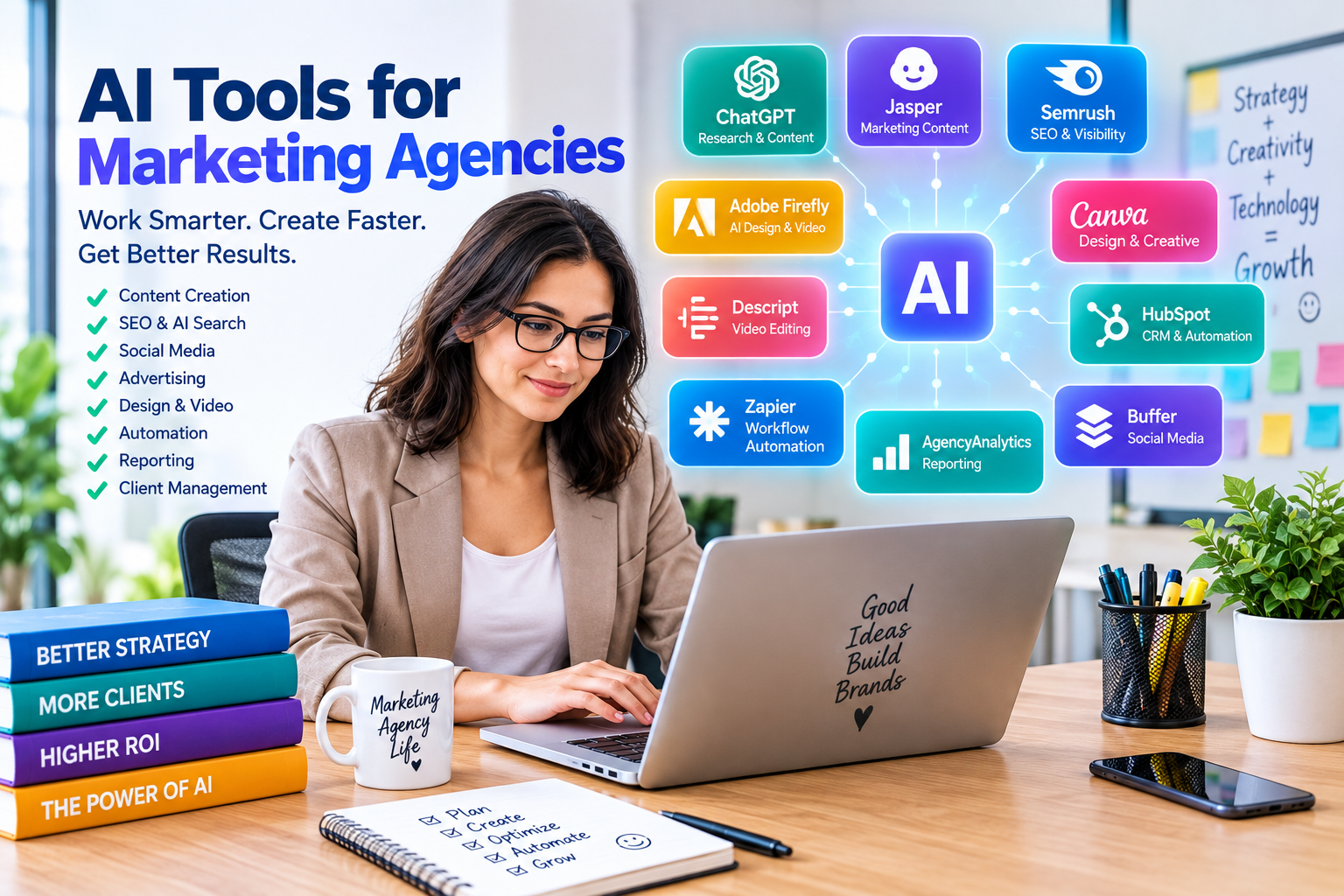
| General AI work | ChatGPT, Claude | Research, strategy, writing, analysis |
| Marketing content | Jasper, ChatGPT, Copy.ai | Copy and campaign content |
| SEO | Semrush, Surfer SEO, Clearscope | Keyword research and content optimization |
| AI search visibility | Semrush, specialized AI visibility platforms | Tracking brand mentions in AI search |
| CRM and marketing automation | HubSpot | Campaigns, CRM and automation |
| Design | Canva, Adobe Firefly | Social graphics and marketing visuals |
| Video | Descript, Synthesia, Runway | Video production and editing |
| Social media | Buffer, Hootsuite | Scheduling and content workflows |
| Workflow automation | Zapier, Make | Connecting apps and automating tasks |
| Client reporting | AgencyAnalytics, Whatagraph | Agency dashboards and reports |
| Research | ChatGPT, Claude, Jasper Research Agent | Market and competitor research |
| Lead generation | HubSpot, Clay and similar platforms | Prospecting and personalization |
The best strategy is usually not to buy one tool from every category. Start with the workflows that consume the most time or have the biggest effect on agency profitability.
What Are AI Tools for Marketing Agencies?
AI tools for marketing agencies are software platforms that use artificial intelligence to help with marketing activities such as research, content creation, SEO, advertising, social media, customer communication, analytics, reporting, and workflow automation.
Some tools are general-purpose AI assistants. Others are specifically designed for marketing.
For example, a general AI assistant can help an account manager summarize a client meeting, analyze campaign data, create a content outline, or brainstorm campaign concepts.
A marketing-specific platform may go further by connecting AI to a company’s CRM, brand guidelines, campaign data, content workflow, or advertising accounts.
The most useful agency AI tools therefore do more than generate text.
They help agencies:
- save production time
- manage multiple clients
- maintain brand consistency
- automate repetitive tasks
- analyze marketing data
- create campaigns faster
- personalize customer communication
- improve SEO performance
- monitor AI-search visibility
- automate reporting
- increase team productivity
- scale services without increasing headcount at the same rate
Why Are Marketing Agencies Using AI?
Agency economics make AI particularly valuable.
An agency may have to produce dozens of social posts, advertisements, emails, landing pages, reports, proposals, and content pieces every month.
Much of that work is repetitive.
AI can help reduce the amount of manual work involved while allowing marketers to spend more time on strategy, creative direction, client relationships, and decision-making.
1. Agencies Can Produce More Content
AI can help create initial drafts for:
- blog posts
- social media captions
- email campaigns
- ad copy
- landing pages
- product descriptions
- video scripts
- content briefs
- campaign concepts
Human editors should still review important client-facing content.
2. AI Can Speed Up Research
Marketing teams regularly research:
- competitors
- industries
- target audiences
- keywords
- customer pain points
- market trends
- content opportunities
- campaign performance
AI can organize large amounts of information and turn research into useful summaries and briefs.
3. AI Can Improve Personalization
Instead of writing one generic email for every prospect, agencies can use AI to create variations based on:
- industry
- customer segment
- buying stage
- company size
- previous interactions
- interests
- campaign behavior
4. AI Can Reduce Repetitive Agency Work
Reporting, meeting summaries, content repurposing, data entry, scheduling, and internal communication can consume substantial amounts of agency time.
Automation tools can connect different applications so that information moves between systems automatically.
20 Best AI Tools for Marketing Agencies in 2026
1. ChatGPT — Best All-Around AI Assistant
ChatGPT is one of the most versatile AI tools an agency can use.
It can support almost every department, including content, SEO, social media, strategy, research, client communication, analysis, and operations.
Marketing teams can use it to:
- create campaign ideas
- write content briefs
- brainstorm headlines
- analyze customer feedback
- summarize research
- create social posts
- develop email sequences
- analyze spreadsheets
- create reports
- write ad variations
- repurpose existing content
- create marketing workflows
Its biggest advantage is flexibility.
Instead of purchasing a separate AI tool for every small task, an agency can use a general-purpose AI assistant for a wide range of workflows.
Best for: Agencies that want one flexible AI assistant for many marketing tasks.
2. Claude — Best for Long-Form Strategy and Writing
Claude is particularly useful for agencies that work with large documents, research material, brand guidelines, and long-form content.
It can help teams analyze:
- brand guidelines
- customer interviews
- research documents
- campaign briefs
- competitor information
- marketing plans
- content drafts
An agency can create a structured project containing information about a particular client and use that context when working on new material.
Best for: Strategy teams, content agencies, researchers, and agencies working with large amounts of information.
3. Jasper — Best for Marketing-Focused Content
Jasper is designed specifically around marketing workflows.
Its strength is not simply generating words. It focuses on helping marketing teams maintain consistent brand messaging across different types of content.
Its Brand Voice functionality allows marketers to provide examples of existing content and establish a recognizable writing style.
Jasper also provides marketing-focused agents and workflows for tasks such as research and content planning.
Best for: Agencies producing large amounts of brand-sensitive marketing content.
4. Semrush — Best for SEO and AI Search Visibility
Semrush remains one of the strongest choices for agencies that provide SEO services.
Agencies can use it for:
- keyword research
- competitor research
- site audits
- rank tracking
- content research
- backlink analysis
- SEO strategy
- AI-search visibility
The AI-search side of marketing is becoming increasingly important.
People are discovering businesses through AI-generated answers as well as traditional search engines. Agencies therefore need to think about both traditional SEO and visibility across AI-powered search experiences.
Best for: SEO agencies and full-service agencies offering search marketing.
5. HubSpot Breeze — Best for CRM-Connected Marketing
HubSpot’s Breeze AI ecosystem is particularly useful for agencies already working inside HubSpot.
AI can support campaign planning, content creation, social content, customer data analysis, personalization, and campaign insights.
This makes it different from a standalone AI writing application.
The major advantage is context.
When AI is connected to CRM and campaign information, it can potentially produce more relevant recommendations than a tool that knows nothing about the client.
Best for: Agencies managing CRM, inbound marketing, lead generation, and multi-channel campaigns.
6. Canva AI — Best for Marketing Design
Canva is useful for agencies that need to create a large number of visual assets without putting every small design request through a professional designer.
AI-assisted design workflows can help marketers create and modify:
- social media graphics
- presentations
- advertisements
- thumbnails
- posters
- marketing materials
- branded visuals
For agencies managing multiple clients, reusable templates and brand assets can make production considerably easier.
Best for: Social media agencies, content agencies, and small marketing teams.
7. Adobe Firefly — Best for Creative Teams
Adobe Firefly is a strong option for agencies already working in the Adobe ecosystem.
It can assist with creative production and image-generation workflows while fitting into broader professional design processes.
This is especially useful when AI generation is only one part of a larger design workflow.
Best for: Creative agencies and professional design teams.
8. Surfer SEO — Best for Content Optimization
Creating an article is only one part of SEO.
Agencies also need to determine whether a piece of content adequately addresses the search intent and topic.
Surfer SEO can help marketers analyze content against competing pages and optimize on-page elements.
It can be useful for:
- content briefs
- keyword-focused content
- topic coverage
- on-page optimization
- content scoring
- editorial workflows
The important thing is not to chase an arbitrary optimization score.
The goal should be creating the most useful content for the searcher.
Best for: SEO content agencies.
9. Copy.ai — Best for Marketing and GTM Workflows
Copy.ai is designed around marketing and go-to-market workflows.
Agencies can use AI to help with:
- sales copy
- marketing content
- outbound messaging
- lead-generation workflows
- content repurposing
- campaign messaging
It can be useful when an agency needs to combine content generation with structured workflows.
Best for: Agencies handling marketing and sales content.
10. Buffer — Best for AI-Assisted Social Media Workflows
Social media agencies need to manage multiple brands, platforms, publishing schedules, and content formats.
Buffer can help organize social publishing while AI features can assist with content creation and repurposing.
A typical workflow could look like:
Client article → AI summary → platform-specific posts → approval → scheduled publishing → performance review
That is much more useful than simply asking AI to “write 10 social posts.”
Best for: Social media agencies and small marketing teams.
11. Hootsuite — Best for Larger Social Teams
Hootsuite is another option for agencies managing multiple social accounts and clients.
Its value comes from combining social management with AI-assisted content and workflow features.
Larger teams may benefit from centralized management, approvals, scheduling, monitoring, and analytics.
Best for: Agencies managing many social accounts and complex approval workflows.
12. Descript — Best for AI-Assisted Video Production
Video is now a major part of marketing.
Descript provides an editing workflow centered around transcripts, making it easier to edit spoken content and turn long recordings into shorter marketing assets.
Agencies can use video AI workflows to create:
- short-form clips
- social videos
- podcasts
- webinars
- interviews
- educational content
One long client interview can potentially become dozens of smaller marketing assets.
Best for: Content and social media agencies.
13. Synthesia — Best for AI-Powered Business Videos
Synthesia focuses on AI-generated video production.
It can be useful when an agency needs professional-looking explanatory, training, onboarding, or marketing videos without organizing a traditional filming session for every project.
Best for: B2B agencies, training content, product marketing, and multilingual video production.
14. Runway — Best for Generative Video
Runway is worth considering for creative agencies experimenting with generative video.
It can support creative visual development, concept generation, and video-production workflows.
This is particularly useful for agencies producing visually ambitious campaigns where traditional production would be expensive or slow.
Best for: Creative agencies and video-focused marketing teams.
15. Zapier — Best for Connecting Agency Apps
Zapier becomes especially valuable when an agency has many different software tools.
For example:
Lead form → CRM → AI enrichment → account manager notification → email sequence
Or:
Published blog → AI social copy → approval → social scheduler
Or:
Campaign data → reporting platform → AI summary → client report
The value of automation is not one individual AI feature.
The value comes from connecting the entire workflow.
Best for: Agencies with repetitive cross-platform processes.
16. Make — Best for Advanced Automation
Make is another powerful automation platform.
Compared with simple automation workflows, advanced visual automation can give agencies more control over branching logic, data transformation, and multi-step processes.
For example, an agency could build a workflow that:
- receives a new client lead
- checks the CRM
- enriches the company information
- asks an AI model to classify the lead
- sends the information to the correct salesperson
- creates a follow-up task
- records the result
Best for: Agencies that need complex automation.
17. AgencyAnalytics — Best for Agency Reporting
Client reporting is one of the least glamorous but most important agency activities.
Agencies need to combine data from platforms such as:
- Google Analytics
- Google Ads
- Meta
- SEO tools
- social platforms
- CRM systems
Agency reporting platforms can centralize this information into client-facing dashboards.
AI can then be used to help explain what happened and identify important changes.
Best for: Agencies managing recurring client reporting.
18. Whatagraph — Best for Automated Marketing Reports
Whatagraph is another reporting-focused platform worth considering.
Its main value is bringing marketing data into centralized reports so teams do not have to manually collect numbers from multiple platforms every reporting cycle.
For agencies, this can reduce repetitive reporting work and create more consistent client deliverables.
Best for: Performance marketing and multi-channel agencies.
19. Clay — Best for Lead Research and Personalization
Agencies that provide outbound marketing or lead-generation services can benefit from tools that combine data enrichment, research, and personalization.
Clay is designed around workflows involving company and prospect data.
An agency can use this type of platform to create more targeted prospect lists and personalized outreach.
Best for: B2B agencies, lead-generation agencies, and outbound marketing teams.
20. AI Visibility Platforms — Best for the New AI Search Era
Traditional SEO is no longer the entire search landscape.
Marketing agencies increasingly need to understand how clients appear in AI-generated answers.
AI visibility platforms can help monitor whether a brand is mentioned in AI search experiences and identify competitors or topics that receive more visibility.
This creates a new agency service opportunity:
AI search visibility optimization.
Agencies can potentially offer clients:
- AI visibility audits
- prompt monitoring
- competitor comparisons
- content gap analysis
- entity optimization
- brand mention tracking
- AI-search reporting
This is an emerging area, so agencies should avoid promising guaranteed rankings or AI citations.
Best AI Tools for Marketing Agencies by Use Case
Instead of asking, “What is the best AI marketing tool?” ask:
“What is the most expensive or repetitive marketing workflow in my agency?”
Then choose the tool.
| Use Case | Recommended Tools |
|---|---|
| General AI assistance | ChatGPT, Claude |
| Content creation | Jasper, ChatGPT, Claude |
| SEO research | Semrush |
| Content optimization | Surfer SEO |
| AI search visibility | Semrush and specialist AI visibility tools |
| CRM marketing | HubSpot |
| Social design | Canva |
| Professional creative work | Adobe Firefly |
| Social scheduling | Buffer, Hootsuite |
| Video editing | Descript |
| AI video | Synthesia, Runway |
| Workflow automation | Zapier, Make |
| Client reporting | AgencyAnalytics, Whatagraph |
| Lead research | Clay |
| Marketing research | ChatGPT, Claude, Jasper |
What Can AI Automate in a Marketing Agency?
AI can assist with much more than content writing.
Content Production
AI can help create:
- outlines
- first drafts
- headlines
- meta descriptions
- social captions
- email drafts
- ad variations
- video scripts
- content briefs
SEO
AI can assist with:
- keyword clustering
- search-intent analysis
- content briefs
- competitor analysis
- internal-link suggestions
- content optimization
- AI-search visibility analysis
Social Media
AI can help with:
- content ideas
- captions
- hashtags
- repurposing
- content calendars
- platform variations
- basic performance analysis
Paid Advertising
AI can assist with:
- ad copy variations
- creative concepts
- audience analysis
- campaign analysis
- performance summaries
- testing ideas
Human marketers should still make important budget and strategic decisions.
Client Reporting
AI can help turn raw marketing data into explanations such as:
- what improved
- what declined
- what changed
- possible reasons
- recommended next steps
This can make reporting more useful than simply presenting a spreadsheet full of numbers.
How to Build an AI Stack for Your Marketing Agency
You do not need 20 AI subscriptions.
In fact, buying too many tools can make your agency less efficient.
A better approach is to build your stack in layers.
Layer 1: General AI Assistant
Start with one strong general-purpose AI assistant.
Use it for:
- research
- brainstorming
- writing
- analysis
- strategy
- internal operations
Layer 2: Your Core Marketing Platform
Choose the platform most closely connected to your primary service.
For SEO, this could be an SEO platform.
For inbound marketing, it could be a CRM and marketing platform.
For social media, it could be a social management platform.
Layer 3: Automation
Once you understand your repetitive workflows, connect them with automation.
Do not automate a bad process.
First simplify the process.
Then automate it.
Layer 4: Reporting
Build standardized reporting so every client does not require a completely different manual process.
Layer 5: AI Visibility
If your agency offers SEO or content marketing, begin tracking how clients appear in AI-generated search results as well as traditional search.
How Marketing Agencies Should Use AI Safely
AI can create major productivity gains, but agencies have an additional responsibility.
They are often handling client information.
That can include:
- customer lists
- campaign data
- sales information
- unpublished strategies
- internal documents
- advertising performance
- customer conversations
Before putting sensitive information into an AI system, agencies should understand the platform’s data controls, privacy terms, permissions, and organizational settings.
Create clear internal rules covering:
- what employees can upload
- which AI tools are approved
- how client information is handled
- when human review is mandatory
- how AI-generated content is checked
- who approves client-facing outputs
Should AI Replace Marketing Agency Employees?
AI is more useful as a force multiplier than as a complete replacement for an agency team.
AI is excellent at speed and pattern processing.
Humans remain essential for:
- strategy
- creativity
- positioning
- brand judgment
- client relationships
- negotiation
- complex decision-making
- ethical judgment
- final quality control
A strong agency should therefore ask:
“How can AI make our marketers more valuable?”
rather than:
“How can we eliminate every human task?”
The agencies that simply produce more low-quality content will eventually compete on price.
The agencies that use AI to improve strategy, speed, personalization, measurement, and client outcomes can compete on value.
How to Calculate the ROI of AI Tools
Before purchasing an AI tool, calculate the potential return.
Use this basic formula:
AI ROI = (Value Created − AI Cost) ÷ AI Cost × 100
For example, suppose an agency spends $100 per month on an AI tool.
If it saves 10 hours of work every month and the internal value of that time is $40 per hour:
10 × $40 = $400 of monthly value
The approximate monthly benefit is therefore $400 against a $100 cost.
But time savings are not the only factor.
Also consider:
- increased client capacity
- faster project delivery
- fewer revisions
- reduced outsourcing costs
- additional services
- improved client retention
- increased campaign performance
Common Mistakes Agencies Make With AI
Mistake 1: Buying Too Many Tools
Ten overlapping AI writing tools will not make your agency ten times more productive.
Choose a small number of tools and learn them properly.
Mistake 2: Publishing AI Content Without Editing
AI-generated content can contain:
- incorrect claims
- generic language
- outdated information
- repetitive ideas
- weak examples
- inaccurate statistics
Human review remains essential.
Mistake 3: Ignoring Brand Voice
If every client receives the same generic AI writing style, your agency’s work will quickly become interchangeable.
Build client-specific brand guidelines.
Mistake 4: Automating Everything
Some workflows should remain human-led.
Automate repetitive processes, not important judgment.
Mistake 5: Measuring Output Instead of Results
Generating 100 social posts is not necessarily better than generating 20 excellent posts.
Measure:
- leads
- revenue
- conversions
- engagement
- organic visibility
- client retention
- production cost
- time saved
Mistake 6: Forgetting AI Search
SEO strategies focused exclusively on traditional search may miss a growing discovery channel.
Agencies should begin understanding how their clients appear in AI-generated answers.
A Practical AI Workflow for a Marketing Agency
Here is an example of how an agency could use AI from strategy to reporting.
Step 1: Client Research
Collect:
- website
- customer information
- existing content
- competitors
- brand guidelines
- previous campaigns
Step 2: Strategy
Use AI to help analyze the information and identify:
- audience segments
- content opportunities
- campaign ideas
- customer pain points
- competitor gaps
Step 3: Content Planning
Create:
- keyword clusters
- content calendar
- campaign themes
- social content ideas
- email topics
Step 4: Production
AI helps create initial:
- articles
- emails
- social posts
- ad copy
- scripts
- creative concepts
Step 5: Human Review
A marketer checks:
- accuracy
- brand voice
- strategy
- originality
- compliance
- claims
- quality
Step 6: Publishing
Approved assets are scheduled or published through the appropriate platforms.
Step 7: Measurement
Collect:
- traffic
- leads
- conversions
- engagement
- ad performance
- search visibility
Step 8: AI-Assisted Reporting
AI can summarize the data and identify patterns.
Step 9: Human Strategy
The account team decides:
What should we do next?
That final step is where agency expertise creates value.
The Best AI Stack for a Small Marketing Agency
A small agency does not need an enterprise-sized technology stack.
A practical starting setup could include:
1 general AI assistant
For research, writing, brainstorming, and analysis.
1 SEO platform
For keyword research, competitor analysis, and SEO measurement.
1 design platform
For social graphics and marketing assets.
1 CRM or marketing platform
For leads, campaigns, and customer management.
1 automation platform
For connecting repetitive workflows.
1 reporting platform
For standardized client reporting.
This is enough for many small agencies to build a meaningful AI-enabled workflow.
The Best AI Stack for a Growing Agency
As an agency grows, the priorities change.
A larger agency may need:
- client-specific workspaces
- centralized brand guidelines
- approval workflows
- CRM integrations
- advanced automation
- multi-client reporting
- AI visibility monitoring
- data governance
- user permissions
- standardized processes
At this stage, the goal is no longer simply saving individual employees time.
The goal becomes building a scalable agency operating system.
How AI Is Changing Marketing Agencies
The biggest change may not be that AI can write faster.
The bigger change is that AI is reducing the cost of producing many types of marketing assets.
That means basic execution is becoming less differentiated.
As production becomes easier, clients may increasingly expect agencies to provide more value through:
- strategy
- creative direction
- customer insight
- positioning
- analytics
- experimentation
- brand management
- business outcomes
In other words, AI can make execution cheaper while making expertise more valuable.
Frequently Asked Questions
What are the best AI tools for marketing agencies?
The best tools depend on the agency’s services. ChatGPT and Claude are strong general-purpose assistants, Semrush is useful for SEO and AI visibility, HubSpot is valuable for CRM-connected marketing, Jasper is designed around marketing content and brand voice, Canva is useful for design, and Zapier or Make can automate workflows.
Can AI help a marketing agency manage multiple clients?
Yes. AI can help agencies standardize research, content production, reporting, client communication, campaign planning, and repetitive administrative workflows.
However, each client should have separate context, brand guidelines, data permissions, and approval processes.
What is the best AI tool for marketing content?
There is no universal winner. General-purpose AI assistants can be highly flexible, while marketing-focused platforms such as Jasper provide additional brand and workflow controls.
The right choice depends on the agency’s content volume, team size, brand requirements, and workflow.
What is the best AI tool for SEO agencies?
Semrush is a strong choice for agencies that need keyword research, competitor analysis, SEO measurement, and broader visibility capabilities. Content optimization platforms such as Surfer SEO can complement an SEO workflow.
Can AI automate client reporting?
Yes. Agencies can automate data collection and dashboard creation, while AI can help summarize performance and identify notable changes.
Human account managers should still review recommendations before presenting them to clients.
Will AI replace marketing agencies?
AI is unlikely to eliminate the need for marketing expertise, but it can reduce the amount of manual execution required.
Agencies that rely primarily on repetitive production may face greater pressure than agencies that differentiate themselves through strategy, creativity, relationships, and measurable business outcomes.
How many AI tools does a marketing agency need?
Most agencies should start with a small stack.
A general AI assistant, one or two core marketing platforms, automation, and reporting are often more useful than dozens of disconnected tools.
Final Verdict: What Are the Best AI Tools for Marketing Agencies in 2026?
The best AI tools for marketing agencies are not necessarily the tools with the longest feature lists.
The best tools are the ones that solve expensive, repetitive problems inside your agency.
For most agencies, a strong AI stack should include:
- ChatGPT or Claude for general AI work
- Jasper for marketing-focused content and brand consistency
- Semrush for SEO and AI-search visibility
- HubSpot for CRM-connected marketing
- Canva or Adobe Firefly for visual content
- Buffer or Hootsuite for social workflows
- Descript, Synthesia, or Runway for video
- Zapier or Make for automation
- AgencyAnalytics or Whatagraph for reporting
- Clay or similar platforms for lead research and personalization
But don’t buy everything at once.
Start with one workflow.
Identify the task that consumes the most agency time. Build an AI-assisted process around it. Measure the result. Then expand.
The winning agency strategy in 2026 is not “use as much AI as possible.”
It is:
Use the right AI, in the right workflow, with the right human oversight, to produce better results for clients at a healthier margin.